Showing posts with label science and history. Show all posts

Thursday, May 19, 2016

Filipinas in History: Lualhati Bautista

Why the author of Dekada '70 deserves to be celebrated. 
No comments

Friday, August 7, 2015

Wait-A-Minute-Or-10


Procrastination begins the moment we wake up and bargain for five more minutes in bed. It continues as we take a moment to scroll through our social media feeds instead of hitting the books, overflows to sneaking in a quick snack a minute before the next class bell — all while telling ourselves “we’ve got time.” Procrastinating is (if you’re like me) a daily ritual that’s rather difficult to break.

Likewise, we are all too aware of the consequences of such a habit — we wake with a start, realizing we’d overslept, constantly cram an entire month’s worth of information in a single night, miss roll call and get ticked off as late or absent because of that hella good sandwich.

And still we continue on in this way, allowing ourselves to remain in the vicious cycle of doing things at the very last minute. Somehow, we all become a version of You’re a Good Man, Charlie Brown. “I’ll get a fresh start tomorrow… and it’s not due till Wednesday… so I’ll… have all of Tuesday unless… something should happen…Why does this always happen…”

I used to peg it down to the law of inertia — we like to keep on doing whatever we’re comfortable doing. I have this habit of just lying on my bed and daydreaming about stories and ideas, and once I’m in this frame of mind, it's quite hard to snap me out. I could go on for hours and hours this way.

Psychology, however, would have it another way. Procrastination, apparently, has less to do with inertia than it has to do with making decisions. The way the brain thinks is still a complex process we barely understand, but procrastination is within and without our control – in a way, it’s a bit of a paradox.

On one hand, everything is chemical. When we hold off on important work and give into our short-term happiness, our brain releases a chemical called dopamine which makes us feel… well, it makes us feel great! This creates a reward pathway, reminding us of how amazing it felt to procrastinate. Of course, it leaves out the stressed out feeling we finally get when we have to sit back down and deal with the consequences of our non-action.

Or perhaps the job itself has once left us with negative feelings. We find it difficult to try new things for fear of failure. The task seems too daunting, like Goliath ten times over. Perhaps we’ve done it before and have gotten hurt. Maybe doing the job feels like confessing your affections for a notoriously cold-hearted heartthrob. The nagging fear of failure can give anyone cold feet. Oftentimes, past experiences lead our instinctive selves to procrastinate.

On the other hand, as we’ve experienced by holding our urge to pee or restraining ourselves from slapping someone right in the face, we humans are capable of deciding against our instincts – even if our urges are driven by a reward pathway.

Often, our prefrontal cortex is associated with our conscious decisions. When we know we ought to be doing the sensible thing (like, oh, I don’t know, writing an article about procrastinating instead of actually procrastinating), imaginary little angels and demons are having a tug of war in our brains. The angels, on the right, are arguing that we really ought to be getting on. We don’t have forever.

Besides, remember the last time we did this? Remember how horrible it was to endure two hours of heavy traffic because we left five minutes later than scheduled?

The demons, on the left, coax us. It certainly won’t be the same this time around. It’s just a little bit of fun. Lighten up! Yet, despite the temptation to follow our demons, self-control tells us it’s possible to listen to our angels—no matter how hard that may be.

In the end, the constant struggle (though real and difficult) is proof of one thing: we are capable of choice. Perhaps this willpower is what makes us human. Our ability to go against our instincts and break the habit of delaying—it’s the stuff of inspirational stories. We always have the option. And really, isn’t that all we need?


Article by Dani
Art by Mika
----

Dani Pua is a storyteller and a Daughter of Eve. She is a curious creature, studying medicine until further notice, and considers herself a ‘citizen of the world.’ (Whatever that’s supposed to mean.) Oh, and she’s also very much fond of lemon squares. She shares some of her stories on blotpress.weebly.com


Mika was supposed to create an apt bio for this article but got
sidetracked by groceries and synthesizers. She also attests to the
truth behind the Charlie Brown Peter Rabbit track and suggests you
listen to it.
No comments

Friday, June 19, 2015

Ice Ice Baby


The Marvel Universe has always been peppered with theoretical science since time immemorial — which is probably why the terms nerd and geek were once used interchangeably, but that’s a subject of an entirely different article.

What I find most interesting is how what was once confined to science fiction is slowly turning into reality — fancy going back in time and telling your younger self that your mobile phone will soon be devoid of text buttons. What a surprise that would be! What constitutes as “possible” is still quite narrow, however — our perspective on the future is always influenced by our perception of reality. Most of the time, we can barely wrap our heads around what may be possible and what is downright scientifically wrong.

It’s natural, therefore, to think the medical technology in the latest Avengers movie was all science fiction. In the last 20 to 30 years, so much progress in science and technology has been made. This progress, significantly powered by the information age, has allowed the unreal to exist. New organs are being reproduced in the lab using 3D printers, enzymes that alter blood type have been discovered and isolated, the technology for prosthetic limbs are now reminiscent of Full Metal Alchemist (well, maybe not yet but we’re getting there). It’s an exciting time for science!

In science fiction, cryogenics is more commonly known as what happened to Captain America between the first and second movies. Theoretically, some organisms are able to go into a dormant sort of hibernating state when cooled to very low temperatures (I mean -150° C levels). Most of these cold loving organisms are of the bacterial nature — we humans are more likely to get frostbite from the extreme weather due to the inability of our bodies to continue keeping warm. The enzymes in our bodies responsible for generating heat and energy can only do so at an optimum temperature. If body temperature falls lower than 37 degrees, the enzymes are inactivated. Thus, our metabolic processes slow down or stop completely. Using the same principle, living tissues are preserved by supercooling due to the inhibition of the damage-inflicting enzymes at subzero temperatures. This branch of cryogenics is called cryopreservation. Of course, we haven’t been able to stuff a human being in a cryo tube and revive him after 20 years (or have we?!?) though it seems theoretically feasible.

Our fascination with cheating death has perhaps spurred the cryopreservation field forward. Some of the living have already decided to preserve their brains upon death by deep freezing—a process called neuropreservation — in the hope that medical advancements will resurrect them into a new body sometime in the future. It may seem like science fiction now, but medicine and technology is always improving. The future may be closer than we think.

If it’s theoretically possible, why has it yet to be done then? Here’s the rub — regardless of one’s belief system, it’s well accepted that scientists have yet to find a way to preserve the soul (or spirit, or essence, or whatever you wanna call it). It all boils down to age old questions: What makes us human? Why are we different from other mammals? Why is the consciousness so unique, so special? These questions, perhaps, are far more interesting than cryopreservation itself.

How we perceive the value of a human life changes based on the technology available, yet we remain relatively the same — as fragile as we were a thousand years ago. Despite the increase in the average life span, we still crave more like Ariel from The Little Mermaid. We want to be able to live longer and healthier lives until mortality is just a word we used to worry about. We crave unlimited health perhaps because we are so aware of how quickly we expire.

“To dust thou art, to dust returneth” directly comes to mind and is perhaps too often on our minds. I remember waking up on my 20th birthday and thinking, “God, I’m old.” Then, “What have I done with my life?” It’s this constant fear of ending before a story has even begun. Our generation has been programmed to yearn for fulfillment. We've probably even invented this whole quarter-life crises phenomenon. We wake up and wonder if we’ll ever make anything out of ourselves. We wonder if we were meant to be heroes or failures. We wonder if we’ve got enough time to do all we wish to do. We wonder if we could do more if we just had a little more years to our lifespan. We wonder if we’ll ever be able to figure out what we’re supposed to be doing with our lives.

Perhaps if I am able to cryopreserve my own brain, I’ll have just enough time to figure my life out before I wake. For now, however, we all have to manage our lives the best way we can with the limited time we have.


Article by Dani
Art by Monique
----
Dani Pua is a storyteller and a Daughter of Eve. She is a curious creature, studying biochemistry until further notice, and considers herself a ‘citizen of the world.’ (Whatever that’s supposed to mean.) Oh, and she’s also very much fond of lemon squares. She shares some of her stories on blotpress.weebly.com
Monique is an almost multimedia artist, a few thousand miles away from NYC, and just an impressive coffee stash away from showing off an impressive coffee stash. Well, she's only 19, it's a work in progress.
No comments

Tuesday, February 3, 2015

World of Blinding Lights


After counting down to one, among the cheering, greetings, and singing—and quite possibly selfie-taking—we entered the year 2015. The year 2014 ended with people enveloped in light. Be it light from inside homes or light from the fireworks being set off and sparklers tracing in the air like magic wands, the dark night sky was definitely filled with light.

Interestingly enough, 2015 has been declared to be the International Year of Light (IYL) by the United Nations Educational, Scientific and Cultural Organization (UNESCO) in an effort to bring awareness regarding the science of light, as well as its importance and technological impacts to the world.

An amazing website dedicated to the IYL was created, and is definitely worth checking out!

Before sharing some highlights in today’s light-based technologies, let’s talk about light for a bit.

What is Light?

Simply put, light is electromagnetic radiation (and not always the bad kind!). In Classical Physics, light is viewed as a wave, which is usually depicted as a squiggle going up and down at uniform heights and depths. Although we refer to light as something visible, light comes in other forms depending on their wavelengths (how long one wave is) and frequencies (the number of waves that pass a point for a certain amount of time), such as microwaves, ultraviolet rays and x-rays.

Light is perceived differently in Quantum Mechanics, where light is said to be composed of massless particles called photons, tiny packets that give light its energy (and this is where the famous E = mc2 equation comes in!).

After some experimentation here and there, scientists came to the conclusion that light exhibits wave-particle duality, meaning it behaves as both a wave and a particle. The composition of light is still a mystery to us and is currently being studied extensively.

The Light Side of the Force

Although the nature of light is not completely understood, scientists are well-aware of how light behaves and apply this knowledge in creating and developing light-based technologies.

Fiber Optics


You know how nothing can travel faster than the speed of light? It would be very difficult to even reach it, given that light’s speed in a vacuum is 3 x 10⁸ meters per second.

Wouldn’t it be great if your internet speed was that fast? If only you could say goodbye to “laggy” Youtube videos and choppy Skype calls. Scientists have been working on using fiber optic cables to transmit information using light. These cables allow light to travel inside through internal reflection: the inside of these cables contains mirror-lined walls designed to reflect light and make light travel longer distances.

This technology is not perfect. Impurities in glass cause light signals tend to degrade as they travel, but they do not degrade as much as electric signals inside copper wires. Fiber optic cables eat up less space than copper wires because they are lighter, thinner and more flexible. They are also more cost-efficient, as less power for transmission and less materials are needed (a win-win situation for consumers and producers). Fiber optic cables are safer than copper wires as well: Since they use light signals instead of electricity, fiber optics aren’t a fire hazard.

Light usually travels only at 69% of the speed of light in optical fibers—this is still insanely fast; I wouldn’t worry too much about slow downloads—but scientists at the University of Southampton have developed cables that allowed data to travel at a record speed of 99.7% the speed of light (Team Rocket blasting off still beat them by 0.3%, though!). This speed contributed to less degradation and therefore a decreased loss of data.

Are you down for cheaper, faster and more reliable internet speeds? Of course you are.

The Thermoelectric Flashlight


As you may know very well, typhoons ravaging the Philippines leave us very prone to losing electricity for extended periods of time. It wouldn’t be surprising for Filipino households to keep shelves filled with candles in case of emergencies.

Ann Makosinski, a Filipino-Polish girl based in Victoria, British Columbia invented a flashlight (and more recently a headlamp) that runs on thermal energy. Her inspiration came from a friend in the Philippines, who at that time failed her grade level due to lack of proper lighting at night.

The device utilizes a tool called a Peltier tile, which converts thermal energy from the body into electricity. Heat—in its everyday definition— from the body transfers to one side of the tile. The tile is cooled on the other side by air passing through an aluminum tube. After developing her thermal flashlight, she went on to working on a thermal headlamp that comes with a handy solar panel and capacitor for electrical charging and storage.

Her flashlight entry in the Google Science Fair earned her an award in the 15-16 age category! One could say Makosinski has a bright future ahead of her.

Lightsabers


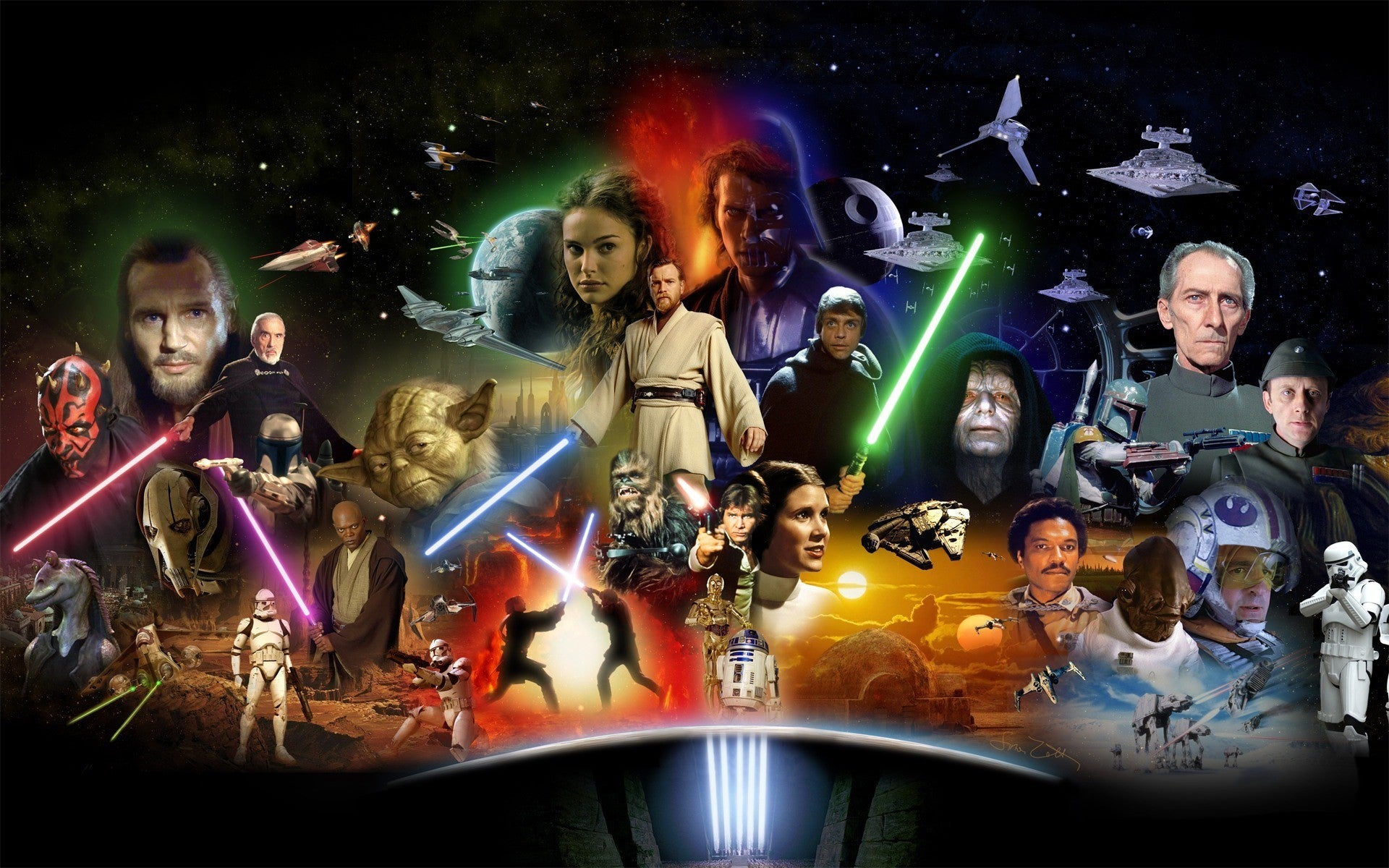
Lightsabers have yet to become a reality for us. Actually, it wouldn’t be physically possible for lightsabers to appear as bright as they do in Star Wars without the presence of a lot of dust to reflect the light produced from the lightsaber, because light can only be seen once it’s being reflected on a surface (besides, George Lucas argued that the Star Wars universe is different from our own and has its own set of physical laws). You are now a few steps closer to your dream of becoming a Jedi Knight. Physicists from Harvard and MIT have managed to bind photons together like molecules. What makes it difficult to get light particles to stick together is that they naturally deflect each other. Rubidium atoms were placed inside a vacuum of a few degrees above zero Kelvin (-273.15 degrees C). Atom clouds formed inside the vacuum, and lasers were used to shoot single photons into the atom clouds. When they began firing two photons simultaneously, they found that the photons would move through atom cloud as one, and stay like that even after leaving the atom cloud.

Lightsabers aren’t exactly a top priority in terms of applying this new technique. A practical application to this is quantum computing, since photons are expected to be the best carriers of quantum information. The next thing these scientists are working on is getting photons to interact.

On the bright side, the absence of lightsabers gives us more time to choose between the light and dark sides of the force. What’s next?

Today we have the chance to enjoy light in ways that may seem unimaginable. There is no doubt, however, that we still have a long way to go before we can fully understand light and maximize its application in our lives. The technologies mentioned here are only three of the many research projects and applications focusing on light (there simply are too many to mention!). Physics research groups across the globe are trying to incorporate light into our lives to the best of their abilities (in fact, the research group of one of the teaching assistants in my Physics class is working on replacing electricity with light).

Can you think of other ways for us to use light? Do you have any machine or device in mind that you’ve always wished existed or will exist soon? Shed some light on your thoughts and ideas in the comments section below!

--

Science has been Andie’s thing since she was four (she once thought the Milky Way was the gateway to heaven). She doesn’t mind being called a geek—because it’s obviously true—and is now a physicist in the making. She believes her puns, jokes and pick-up lines are amazing, even if everyone else around her doesn’t. Andie constantly thirsts for adventure, and is ready to give almost anything a try.
Ginny is a self-proclaimed aesthete majoring in Advertising Arts. Aside from art, she enjoys baking, playing video games, watching animations, and getting distracted by cats. While still uncertain as to what she exactly she wants to become, she has an unwavering ambition to pursue a career in the art world.
No comments

Sunday, January 11, 2015

After Life


I have a penchant for things with a history -- which could be anything from a famous artifact to a person to a place. There's a thrill in getting to see a famous artwork close enough to count the strokes of paint, or standing in the same spot someone was brutally murdered. Nothing gets me more excited (and melancholy) than that.

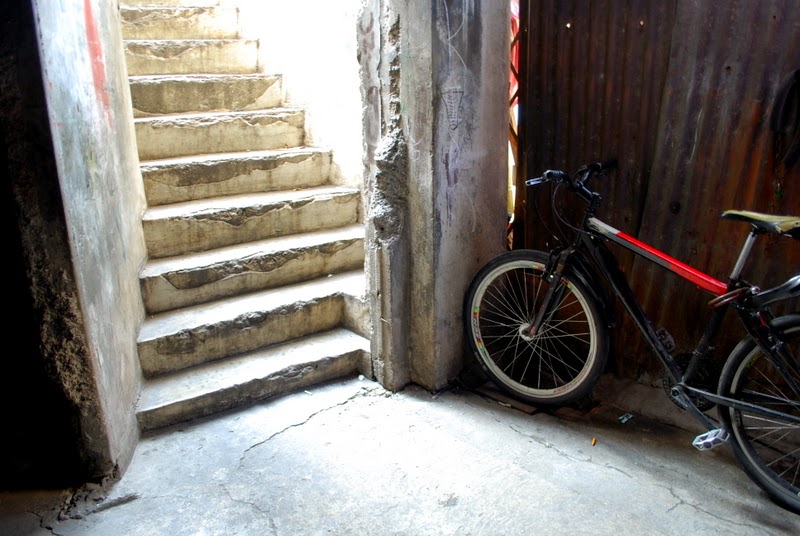
I started taking photos of abandoned buildings for a class, but it all ended up just being for me. These places are swarming with ghosts, with stories, of the people who chose to spend moments of their lives in them. All of these people are gone now, and only those who want to remember will remember their stories.

Welcome to the afterlife.

----

The Aduana Building is a Spanish-era customs house in Intramuros. This building has been through an earthquake, demolition, reconstruction, World War II bombings and artillery, and -- wait, there's more! -- eventually abandonment after a fire in the 70's. It still stands, with a multitude of plants battling to escape its confines.


----

The Diplomat Hotel in Baguio City is known for its ghosts and its myth before anything else -- rightfully so, considering that it was a vacation house, convent, school, sanitarium, and sanctuary before the Japanese bombed it in World War II. Right after the war, some genius decided to build a hotel and hold psychic surgeries in there. The city has declared the hotel a heritage site since then.


----

The Forum was a standalone theater built by Pablo Antonio, a National Artist for architecture, in the 60's. It's located in Rizal Avenue, which was practically the center of life in Manila before it became a victim of the construction of the LRT. As with other theaters, it eventually closed down and its shell now houses several families.


Photos and descriptions by PaCho
----
PaCho  is the nickname of a full-time fangirl who wants an infinite amount of money with which to travel the world and buy merchandise. This girl is currently amassing the skills to achieve these goals, and collecting stories and perspectives along the way (to consequently be the best that no one ever was) at a university. She will smile in satisfaction at the fall of the patriarchy and Western domination of international affairs. She is only half-joking about this (which means that she's completely serious).
1 comment

Thursday, January 8, 2015

Twinkle, Little Star


The stars glisten clearly in the night sky when you lay eagle-sprawled on a patch of grass in the countryside. There’s a mystical sort of majesty that comes with witnessing a sun shine from thousands of lightyears away. The night sky, when lit with countless constellations, leaves us awestruck--and rightly so. Just as Muggles have wondered about the existence of wizards, so have we wondered about the lives of stars –– how brightly do they shine? How are they even capable of shining? How far are they from our eyes? Why on earth are they so captivating?

Stars are actually far-off suns –– more accurately, our sun (that big yellow thing that tells us that it’s morning on our side of the globe) is in fact a star. These bright stellar orbs are completely luminescent objects made of plasma, meaning if they were people, they would be giving a whole lot of love without taking any for themselves. Isn’t that nice of them?

Despite their luminescent nature, not all stars are visible to the naked eye. In fact, on a good night, a person can only see between 2,000 to 2,500 stars in the night sky. Considering there are millions of stars out in space, the number is minute in comparison. The fact that we cannot see a star does not diminish its brightness, however. Just as it is so easy for us to overlook the potential of a stranger compared to the potential of a friend, it’s all about perspective. This biased view of the stars is called apparent magnitude and refers to how bright stars seem with respect to our view from earth. Though it seems logical to measure a star’s brightness based on how we perceive it, it’s a pretty narrow perspective. What about the other stars we are unaware of? Are they of less value?

Just as indie kids take pride in discovering obscure new artists who deserve to make it big but just haven’t been found yet, astronomers scour space for stars we may not be able to see. They’ve found out, in fact, that the brightest stars are those under the most amount of pressure. A star’s light is generated when hydrogen atoms fuse to form helium, which is like colliding two lives together so fiercely to form a single unit. Put two human beings with an intense attraction for each other in a small-ish space, and pretty soon a reaction will take place. The magnitude of the reaction will depend on how strong the attraction is –– people are held together by figurative magnetic fields even as stars are held by literal ones.

Sometimes, our lives collide so hard with another person’s that all that is within us suddenly fuses with the other. We are left as aliens in our own bodies. The impact of such an interaction left us completely changed. There are people who come like hot flashes of light: people who force themselves past our fortified gates, people who we wish could stay, people who cause us to change.

But sometimes, these people cause us to collapse into volatile, unpredictable, T-Rex versions of ourselves the way stars become supernovas before their inevitable demise. As stars reach the end of their lifespans, some decide they will not go so gentle into that good night. Instead, they decide to leave the universe with the memory of their dramatic flare. Just as there are people who we cannot sever ties with docilely. Sometimes, the best friendships end in an explosion. Perhaps we’ve given far too much of our hydrogen away, created too much helium to detach ourselves peacefully.

And sometimes, explosions are simply natural. When a supernova is formed, the star’s core collapses into itself before it explodes. It’s akin to having that one last meltdown before you decide it’s time for things to come to an end. It might well involve yelling, and crying, and perhaps even attempted murder, but at that point in time you know for certain: this is the end. And in this stage, the supernova releases so much energy that it could well outshine its other neighbors for days or weeks on end.

And perhaps, back here on earth, if we were ever to see supernovas, perhaps we’d be captivated by their existence. Perhaps for a moment in time, we look upon volatile stars and believe they can light up our darkness simply by existing. Perhaps they seem like the hope at the end of the tunnel –– those who have made it past the bleakest periods of their lives, those who have chosen to end their suffering despite the very real possibility of exploding into a billion fragments of themselves. Perhaps they are the reasons we ourselves find the courage to allow our cores to collapse inwards, and say with the loudest explosion we can muster “enough is enough.”


Article by Dani
Art by Ginny
----

Dani Pua is a storyteller and a Daughter of Eve. She is a curious creature, studying biochemistry until further notice, and considers herself a ‘citizen of the world.’ (Whatever that’s supposed to mean.) Oh, and she’s also very much fond of lemon squares.


Ginny is a self-proclaimed aesthete majoring in Advertising Arts. Aside from art, she enjoys baking, playing video games, watching animations, and getting distracted by cats. While still uncertain as to what she exactly she wants to become, she has an unwavering ambition to pursue a career in the art world.
No comments

Thursday, December 25, 2014

A Star is Born


The parol—a classic example of Christmas tradition in the Philippines—is a symbol of hope, light, triumph, and many other things. As a predominantly Catholic country, most Filipinos view the parol as the physical manifestation of the Star of Bethlehem, the star that brought the three kings to the infant Jesus.

But the origins of the parol aren’t as grand as the finding of Jesus Christ in the manger. It’s a humbler story of a salt vendor.

The Spanish Era
Francisco Estanislao was a salt vendor from San Fernando, Pampanga. He created the first parol using bamboo and Japanese paper back in 1908. (FRJimenez)  

His parols were used to illuminate the path to the Church for Misa de Gallo or Simbang Gabi, a custom still observed by many Filipinos in the country and around the world.

Back then, parols were round with a small lit candle to give it light.


Present Day
Nowadays, parols are shaped in many forms, though still resembling the classic five-point star, and made of varying materials such as colored plastic, cellophane, and capiz shells.

Pampanga remains the parol capital of the Philippines living up to the Pampangeño that started it all. Yearly, the province hosts its Giant Lantern Festival that features some of the biggest dancing lanterns that bop to different tunes. This year, nine barangays in Pampanga vied for a spot in parol making history at the festival as well as a Php 150, 000.00 grand prize.

It no longer lights the way to churches, but serves as decorations in houses, public and private buildings, and along roads and highways. It has even been brought to other countries.

One of the more popular international parol celebrations is at the Wiener Christkindlmarkt (Vienna Christmas Market) where 60 different parols were lit on a one-of-a-kind Filipino Christmas tree (Balana).

More than a sideshow at international festivals, Filipinos who spend their holidays away from home and country have taken to putting up parols as their connection back to the Philippines. It is a reminder of where they came from (Orejas).

In a time of widespread migration, parents, siblings, daughters, and sons abroad need some kind of connection to their home especially during a season so widely known for the rekindling of family ties.

Surely, the parol has come a long way from its humble origins in San Fernando, Pampanga. It once guided townsfolk toward churches. Now, it’s guiding people back to their roots, to their homes. It has become a beacon of hope and a symbol of home for both Filipinos and foreigners alike.

For a glimpse of this year’s Giant Lantern Festival, watch GMA News’ special coverage:


Works Cited:
Balana, Cynthia D. “’Parol’ a big hit in Austria.” Inquirer.net. The Philippine Daily Inquirer. 11 Nov. 2007. Web. 12 Dec. 2014. 

FRJimenez. “Unang parol sa Pinas.” GMA News. GMA Network. 21 Dec. 2011. Web. 12 Dec. 2014

Orejas, Tonette. “Pampanga’s ‘parol’ goes global.” Inquirer.net. The Philippine Daily Inquirer. 11 Nov. 2012. Web. 12 Dec. 2014.

Article by Anna
Art by Pio
----

Pio is an aspiring animator and artist. A gentle giant, it's hard for him to go unnoticed anywhere, but gives him attention when he draws in public.
1 comment

Friday, November 28, 2014

A Moment In Time


And the walls kept tumbling down in the city that we love.

Sound familiar? That’s a line from the song Pompeii by the English rock band Bastille. If taken literally, the lyrics may have been simply describing the tragedy in AD 79: the first volcanic eruption of Mt. Vesuvius that completely buried the Roman city of Pompeii and its neighboring areas. But what is the point of even capturing it in the music?

Pompeii was a small but wealthy city in southern Italy during the reign of Roman Empire. Back then, the empire ruled over much of the known world. Various goods like gold and artworks were exchanged among different Roman cities, most of which also traded with neighbors like Greece and Spain, from whom they acquired luxuries like jewels and glassware.

Ten kilometers away from the city stood a mount called Vesuvius. In AD 62, years before the explosion, Pompeii was severely destroyed by a massive earthquake. In the following years, especially a few weeks before the volcano exploded, there had already been minor tremors that the people ignored.

Finally, it came. The 24th of August of the year 79 was to be the last day that Pompeii would be physically remembered for a long time. A famous naturalist named Pliny the Elder, who lived in the nearby city of Misenum, noticed an unfamiliar darkness above the volcano around noon. He then received a call for help from a friend named Rectina, who lived near the volcano, so he traveled to Pompeii. Unfortunately, his efforts led to his demise, as toxins from the ash scattered poison in the air. His nephew, Pliny the Younger, who witnessed the eruption as well, wrote a detailed account of what he and his uncle saw. In his account, he described “broad sheets of fire and leaping flames that glared through the darkness of the night.”

The tragedy, brought on by a thunderous explosion, caught the people by surprise. Winds scattered the clouds of ash southward, further spreading danger. Ash and volcanic rock showered Pompeii and other cities for more than 19 agonizing hours. Rapidly-flowing streams of burning gas and ash called pyroclastic flows buried the cities. Thick, black clouds of ash blocked the daylight over the area. As if all this was not enough, the volcano erupted again the next day, this time with much greater power. More ash and pumice, combined with rain, erased any traces of Pompeii’s civilization.

The buried city of Pompeii was forgotten.

The Death of Pliny by Pierre-Henri de Valenciennes (1813) 

One day in 1709, a farmer named Resina found marbles on a well – this led to a hunt for lost cities. Then, in 1864, a man named Giuseppe Fiorelli led excavations in the area and became famous for developing methods in tracing people and other things that had decomposed over time. A decomposed body could be traced because it leaves a space inside the ground. One way to see how it looked like is to fill the spaces with liquid plaster to form a cast, which would be removed from the ground after it dried out. Fiorelli’s team also discovered artifacts and other objects that showed how the Pompeiians used to live, and the excavation itself told us even more.


Fiorelli’s method of tracing bodies 

Most activities took place in the main square, or the forum, where people worshipped their deities in temples and went shopping. They also loved to write and draw grafitti on the walls, where they shared their feelings about their experiences, whether these were love messages or students complaining about their teachers.

Education was very important. Young children were tutored at home: boys studied law and sports, while girls were taught household activities like weaving. Lazy pupils were beaten and whipped by tutors to discipline them.

Children matured early since they were treated like adults to prepare them for the real world. Boys held a coming-of-age party at the age of 15, in which they offered their bulla to the gods by placing it on their household shrine, the lararium. A bulla was a golden amulet worn by baby boys which symbolized the baby’s freedom, meaning that he was not a slave. Meanwhile, by the age of 14, girls were considered as adults and parents could arrange their daughters’ marriage. This was not easy, though, since they were very superstitious and chose the dates for events carefully. They avoided holding events in May, when they paid homage to the dead.

Of course, people had time for leisure, too. Like any other person, Pompeiians loved to take baths. Their public baths were divided into several parts: women’s baths were separated from the men’s, with each having hot, warm, and cold rooms. Public baths, although used by people to relax, were described as noisy places where people chattered and sang loudly.

The amphitheatre

Pompeiians loved going to the theatre, where they watched plays of different genres. They also went to the amphitheatre to watch gladiators fight with each other. Most of these gladiators were slaves, while some were volunteers interested in the prize money. Just like today, fans from opposite sides sometimes fought – usually with knives.

The houses of rich Pompeiians were really huge, like the so-called House of the Faun, which was so named by archeologists because of a statue of a faun in the main courtyard or atrium. The gardens and ponds allowed people to relax and play games outside. Slaves served as cooks, who also used some kitchen utensils we use today, like graters and strainers.

The House of the Faun 

With the help of preserved bodies, writings, and personal writings from Pompeii, we are able to see how these people lived before their civilization was erased by the eruption of Mt. Vesuvius. If there is something truly significant about the excavation of the city of Pompeii, it is that it tells us that these people lived. It is physical, occupying space, an image we can touch and feel that literally brings one back 2000 years, when the walls kept tumbling down in the city that we love. Bastille’s Pompeii brings us back to a place we once were. For Pompeii, is not just about Italy in itself: It is about the history of humanity captured in a moment in time.

Pompeii today

Sources: 
“Archeological Site of Pompeii.” Photograph. Shore Excursions. Cooperativa Tasso, 2014. 14 Nov 2014. Berry, Joanne. “Amphitheatre.” Photograph. Pompeii Art and Architecture Gallery. BBC, 2011. Web. 14 Nov 2014. 

Cole, Michael. “House of the Faun.” Photograph. House of the Faun. Pompeii Virtual Tour, 2001. Web. 14 Nov 2014. 

De Valenciennes, Pierre-Henri. The Death of Pliny. 1813. Musee des Augustuns, Toulouse. Napoli Unplugged. Web. 14 Nov 2014. "Eruption of Mount Vesuvius Begins." History.com. N.p., 2014. Web. 10 Nov 2014. 

Rice, Chris, and Melanie Rice. Pompeii: The Day a City was Buried. London: Dorling Kindersley Ltd., 1998. Print. “Rome Fiorelli.” Photograph. Ancient Rome. Mollet Learning Academy, 2012. Web. 14 Nov 2014. 


Article by Venice  
Artwork by Maia

---
Venice has been an ardent lover of anything connected to history since childhood, may these be novels, movies, or songs. 


Maia Sevilla loves chocolate cake, napping, and her dog, Fender, more than most things. While she dreams of being the perfect cross between an astronaut and a pastry chef, she is willing to let that go in order to be a fully functional 19-year-old Fine Arts student out to save the world.
No comments

Saturday, October 18, 2014

Critical Point


The drawn out moments before the exam results come out, the breath caught in your throat when you’re sure your parents have discovered your well-hidden stash of chips, the second right before you’re bullied into taking a dare, the moment you’re quite sure your boss has decided to fire you for your apparent incompetence—one thing is for certain. We have all (one way or another) felt the sweat tingling sensation of high pressure. It’s not much of a tingling sensation, really. It’s more of a claustrophobic, humid, elephants-pressing-against-all-sides sort of sensation.

High pressure situations are everywhere, and in physical chemistry, there exists a certain point called the critical point. Also known as the critical state, when a substance (in general) undergoes extreme pressurisation at extremely high temperatures, it reaches a point where no phase boundaries exist.

To explain this amazing phenomena further, I suppose we’ll need to dig up some elementary chemistry.

Just as we are, in the comfort of our own happy places, in a state of bliss and, in the presence of our worst adversaries, in a state of grumpy Grinch-ness, substances also go through phases in different circumstances. Their phases, perhaps like ours as well, are dictated by temperature and pressure. Water, for example, is liquid at room temperature. When it reaches 100 degrees Celsius, it boils. When it reaches 0 degrees Celsius, it freezes.

Naturally, the hotter it gets, the harder it is to keep one’s temper in check. It’s the same thing with any substance: as the temperature increases in a constant volume container, the molecules freak out and start hyperventilating. They move, and twist and just can’t sit still, and can’t (for the sake of this thought experiment) be sedated, thus bumping against the walls and fellow molecules. Consequentially, all that moving about causes an increase of pressure—which is not necessarily a terrible thing. High pressures and high temperatures do, in certain circumstances, improve one’s self.

In fact, the concept behind distillation is precisely separation by fire (figuratively speaking, that is). Distillation simply separates an impure mixture, such as crude oil, into its many components by heating it up, and separating the compounds that boil at different temperatures. This is, in effect, how we human beings ‘refine our search’ as well. In high stress competitions, those who do not break down into a fit of tears are those who eventually make it to the next round. The rest get weeded out because their figurative boiling point was not high enough.

But isn’t there such a thing as too much pressure? The kind of pressure that does not help at all? The kind of pressure that comes about in, oh, I dunno, a war for example, that leaves a person traumatised for the rest of his life?

I suppose this is an example of a ‘phaseless’ state. After the second World War, there were many soldiers who came back with what we now know as post-traumatic stress disorder. Left alone, soldiers with PTSD are unable to re-adjust to life back home. They can’t cope with mundane life after all the horrific tragedies they’d witnessed in the battlefield. Regular, social boundaries are breeched—surely not to be rude, but simply because these boundaries no longer occur to them. Their emotions are not fully under their own control. Clacking of plates could set off terrible memories of gunfire that eventually lead to a seemingly irrational outburst.

The critical point is somewhat like that. It’s not a liquid, or a solid. It’s not a distinguishable phase per se. It’s this misunderstood fragment of circumstances where its boundaries have just scrambled up and vanished.

And it is in these critical points and phases (or non-phases) when we are most irrational, most convoluted, most rash, but perhaps also most human in our damage. The fragility of our spirit perhaps shows us how we can be broken—and perhaps reminds us that we must tread carefully, lest we push others to their breaking point.

Article by Dani
Art by Shandra
--
Dani Pua is a storyteller and a Daughter of Eve. She is a curious creature, studying biochemistry until further notice, and considers herself a ‘citizen of the world.’ (Whatever that’s supposed to mean.) Oh, and she’s also very much fond of lemon squares. She shares some of her stories on blotpress.weebly.com.


Shandra is currently a Communication Arts student. She is interested in multiple art forms such as theater, film and photography.  After college, she plans to enter the world of film and entertainment. 
No comments

Saturday, September 27, 2014

Peter and Catherine: The Two Greats


Snow. Communism. Cold War. Red Square. Vodka. Tsars.

These may be the first things that come to mind when we encounter the name “Russia”. This huge country in Eastern Europe, with a land area that covers one-sixth of the whole planet, grew to be very powerful. This progress happened due to two of Russia’s greatest rulers, Peter the Great and Catherine the Great.

Before their respective reigns, Russia was a backward country overshadowed by other Western European countries that had many scientific and technological advancements and developments. Russia did not have any of these, until it came under the reigns of Peter the Great and Catherine the Great, who led cultural revolutions in Russia in two entirely different centuries.

Peter the Great
Peter the Great Peter I, who stood at almost 7 feet, was born in 1672 and ruled for around 43 years, during which he greatly modernized Russia and made it a major power. By traveling to various places outside his country, Peter was able to learn many new things which he eventually introduced to his own country. He simplified the Russian alphabet (called “Cyrillic”), brought new books and words into society, expanded the borders of Russian territory, and improved trade and industry – among others. That is why his countrymen liked to call him “great” – thus the name Peter the Great.

He strengthened the army as well as the navy. His fascination with science and technology combined with his childhood interest in warfare inspired him to build a strong army and navy. Before his reign, the Russian army was very weak and comprised of mere villagers who had little knowledge about warfare. By what he saw in his travels to other countries, particularly England and Holland, he was motivated to strenghten his nation’s armed forces. Following the industrial success he engineered, Russia became the world’s top producer of iron, which in turn enabled Russians to the produce their own weapons. More importantly, military training was uniform to everyone to turn the army into professional soldiers. Towards this end, Peter the Great brought military experts from other countries and ordered for the construction of ships which he himself designed.

Changes in people’s lifestyles. Prior to Peter’s reign, the Russian men wore long beards and were used to sleep with their shoes on, a habit they carried for centuries as followers of the Russian Orthodox Church. Russian men were not used to shave their beards because these represented their religion’s ideas of manhood. But, as Peter traveled across Europe, he saw how different the Russians were and so wanted his own people to be similar with the other Westerners he encountered. Hence, he ordered all men to cut their long beards off and to remove their shoes when in bed. Basically, he wanted them to act more like progressive Westerners, and even encouraged the Russians to dress up just the way foreigners did. Now, the question: what happened if someone disobeyed him? Well, to those who did not shave their beards, heavy taxes were imposed on violators. But worse, those who did not remove their shoes when going to bed had to deal with this stern personal order: “Ladies and gentlemen of the court caught sleeping with their boots on will be instantly decapitated.” Enough said, no one dared to violate the master’s order.

Most importantly, he founded a great city called... St. Petersburg. As you can guess, he founded it and named it after himself. However, by adjoining a reference to St. Peter in naming the city, he was in effect identifying himself with the side of the first pope of the Catholic Church. As such, he also moved the Russian capital from Moscow to St. Petersburg, and ordered the establishment of schools, churches and palaces. One of the most well-known landmarks is the Peterhof Palace, which, in German, means “Peter’s Court.” Interestingly, it is also known as the “Russian Versailles” due to its majestic appearance and grandeur, and is famous for its parks, gardens, and fountains. Now, St. Petersburg is known as one of the most beautiful cities in the world and is also the location of many commercial and international establishments. Due to its Western aura, it is often dubbed as Russia’s “window to the West”.

Peterhof Palace, St. Petersburg
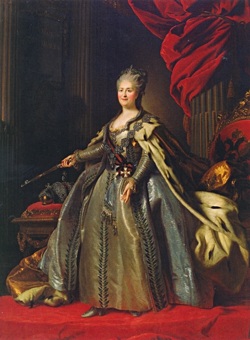
Decades after the reign of Peter the Great, history repeated itself – albeit in another place. In 1729, a certain Princess Sophie was born in the German kingdom of Prussia. In time, this young Sophie became known as Catherine the Great. After her arranged marriage with Tsar Peter III of Russia, who was the grandson of Peter the Great, she became better known as Catherine. On her own, she learned how to read and write in the Russian Cyrillic and studied all available sources about Russia and its history. Catherine then received mass support because of her intelligence and leadership skills. On the other hand, her husband was hated by the people for being a failure in leading the coutry. Peter III was far from his grandfather: he only loved Prussia, where he grew up, and did not care about Russia and its people. Worse, he disliked the Russian Orthodox Church and even secretly supported the Prussian army during the Seven Years War in Europe that involved Russia and Prussia. It became public knowledge that he only loved parades, drinking and... Prussia. These annoyed Catherine, so she became determined to take the reign instead. Entries in her memoirs revealed later on that she had lost her respect for her husband whom she referred to as an “idiot” and a “drunkard from Holstein”. Because of this unfortunate situation, Catherine was alleged to have disposed of her husband herself. Having lost the support of both the nobles and the army, Peter III was eventually forced to step down. Some accounts say that he was assassinated, while others claim that he committed suicide. Whatever the truth, Catherine officially ascended the throne, and so began the Golden Age of the Russian Empire.
Catherine the Great
During her reign, she continued Peter the Great’s efforts in giving Russia a high status in Europe. She, too, westernized Russia, promoted trade, founded new towns, reformed the government, and supported the arts. Again, among other things.

She established numerous schools, including a school for girls. Probably the most famous school that Catherine the Great established is the Smolny Institute for Noble Maidens, which aimed to “educate women, good mothers and useful members of family and society.” In this particular school, strict measures were used to ensure the students’ discipline as they grew up.

She expanded Russia’s territories. Just like Peter the Great, Catherine was able to expand Russia’s borders. The difference was that Catherine successfully obtained a huge portion of the lands on the south and west of Russia, which Peter was not able to do. The Russian empire got that much bigger when it occupied Crimea, Ukraine, Poland as well as other areas in Central Europe. This was the result of Russia’s successful battles against the Ottoman Turks as well as the Poles and the Swedes.

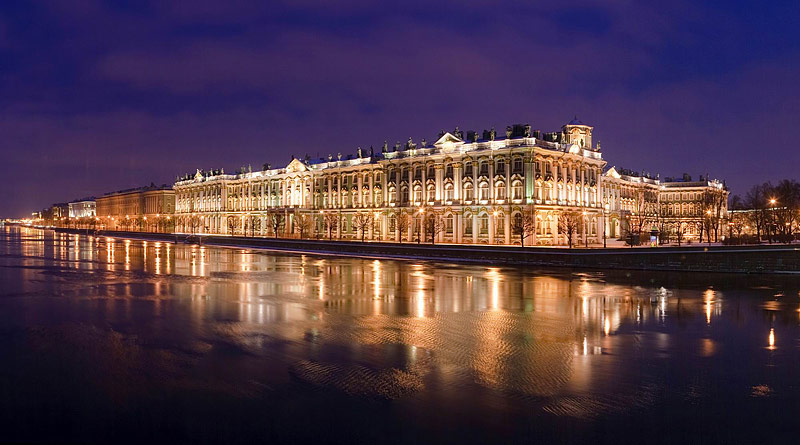
She founded the Hermitage Museum and built (more) palaces. The Hermitage Museum can be found in five adjacent buildings, one of which is the famous Winter Palace. This museum houses more than 2 million art exhibits, including those by famous painters such as Michelangelo and Vincent Van Gogh. The Hermitage is known to be the largest art gallery in Russia, and is so huge it would take a visitor eleven years to see all the exhibits kept there.
Winter Palace, St. Petersburg
All of these advancements and developments contributed immensely to the continued progress of Russia. The stories about these two great rulers suggest that new ideas, when properly utilized for the well-being of the majority, lead to a national transformation. But it is also necessary that rulers should be able to sustain what had been previously achieved. Otherwise, the glories of the past shall have gone to waste, which to some extent is happening to Russia now.

Today, Russia has lost possession of some of the territories that they once proudly annexed. Under a communist regime, national priorities have changed. But even then, at least the world will remember that two great rulers planted the seeds from which a progressive culture grew in Russia, that eventually gave the world first class ballet, orchestras, composers like Peter Tchaikovsky and Sergei Rachmaninoff, periodic table inventor Dmitri Mendeleev, and many more. Without these, people around the world not have enjoyed life the way they do today.

Indeed, the Russia of today has become some kind of an irony. Culturally, it has made countless contributions towards the development of world culture. At the same time, however, it has become threat to world peace because of its military adventurism under a communist regime. How the balance will be tipped is something we will have to see.

Sources: 

Aleksandrova, Kristina. “Catherine’s Maidens – Beautiful, Plain, Noble.” The Moscow Times. The Moscow Times, 2010. Web. 19 July 2014. 

“Catherine the Great (1729-1796).” BBC History. n.p., 2014. Web. 19 July 2014. 

“Catherine the Great Biography.” History of Russia. n.p., 2012. Web. 19 July 2014. 

Cheney, Ian. “How Peter the Great Modernized Russia.” Construction Magazine. n.p., 2013. Web. 18 July 2014. 

Delaroche, Paul. Peter the Great. 1838. Fine Arts Museum of San Francisco, San Francisco. Peter the Great Music Academy. Web. 20 July 2014. Gilligan, Maggie & Linder, Samantha. “Major Accomplishments.” Catherine the Great. n.p., n.d. Web. 19 July 2014. 

“Grand Cascade and Palace in Peterhof, St. Petersburg.” Photograph. Peterhof Palace and Garden (Petrodvorets). Viator, 2011. Web. 20 July 2014. 

Kipreeva, Alyona. “Peter III.” Russiapedia. n.p., n.d. Web. 7 Aug 2014. Massie, Robert K. Nicholas and Alexandra. New York: Dell Publishing, 1985. Print. “Peter III.” Bio. A&E Television Networks, 2014. Web. 23 July 2014. 

“Peter III.” RusArtNet.com. n.p., 2012. Web. 4 Aug 2014. “Peter III (Emperor of Russia).” Encyclopedia Britannica. Encyclopedia Britannica, 2014. Web. 4 Aug 2014. “Peter the Great.” History Learning Site. n.p., 2006. Web. 19 July 2014. 

“Peter the Great – Military Reforms.” History Learning Site. n.p., 2006. Web. 6 Aug 2014. “Peter the Great Accomplishments.” History of Russia. n.p., 2012. Web. 19 July 2014. 

“Peter the Great, Reigned 1682-1725.” Royal Museums Greenwich. National Maritime Museum, 2014. Web. 19 July 2014. 

“Peterhof (Petrodvorets).” Saint-Petersburg.com. n.p., 2014. Web. 19 July 2014. Rokotov, Fyodor. Portrait of Catherine II. 1780. Hermitage, St. Petersburg. WikiArt.org. Web. 20 July 2014. Scicluna, Ken. “Winter Palace.” Photograph. St. Petersburg in 11.5 Hours. Condé Nast Traveler, 2012. Web. 20 July 2014. 

“September 5 in History.” Russiapedia. n.p., n.d. Web. 4 Aug 2014. “St. Petersburg.” Lonely Planet. Lonely Planet, 2014. Web. 19 July 2014. “The State Hermitage Museum.” Saint-Petersburg.com. n.p., 2014. Web. 19 July 2014.

Article by Venice
Artwork by Tamika


----
Venice has been an ardent lover of anything connected to history since childhood, may these be novels, movies, or songs.


Tamika has been around some 18 years and now she's an art major. Loves salmon sushi and has a dog named Taco. 
1 comment

Friday, September 19, 2014

The Inevitability of Chaos


Chaos, it seems, is inevitable.

Whether it be the state of your school’s corridors, or your room, or your grades, or your amorous relationships—life seems to unravel into a disorganized mess that can’t wait to blow up in your face.

As it happens, the chemists of old have formulated an explanation for this strange (and often frustrating) phenomenon.

We call it entropy: ultimately, it is the likelihood that the universe will become disorderly. At any given moment, the entropy of any spontaneous process is positive. This means that the most likely course of any event will lead to random disorder.

At first glance, it would seem like the universe is playing a rather cruel game: why is everything more likely to unravel instead of falling carefully into place? Is the universe quite literally conspiring against us?

Although it would seem that way, the universe is entirely impartial. It just so happens that there are infinitely more ways to unravel a system than there are to organize it. To explain this further, imagine that you had a sock drawer filled with all kinds of socks (or, if you’d rather, imagine you’re looking at Dobby’s sock drawer instead) — red ones, blue ones, striped ones, polkadot patterned ones, cat eared ones — and they’re all arranged in perfect order. They’re color coordinated, arranged by length, arranged by cloth type—whatever, they’re extremely organized. Imagine the number of ways you could disrupt that organization: you could organize them in random colors, you could un-pair your socks, you could unfold them and stuff them back into the drawer.

There are more ways to disorganize your sock drawer than there are to organize it— and before anyone gets all philosophical with me by saying that ‘technically if they aren’t color coordinated, they’re still organized,’ let me continue on to explain how not all organizations are preferred and not all organizations are stable.

For example, if you had a dozen tennis balls and you organize them into a pyramid, right when you let go of them, they will roll off. They will not remain pyramidal at all. It is not the most stable form, and thus will not remain organized.

But also, some organizations are not preferred. Just as you’d prefer to spread butter onto bread, you wouldn’t spread butter onto strawberries. Given the option between buttered bread and buttered strawberries, the latter is simply not the preferred combination. Just as sometimes, two people in a relationship are incapable of cooperating no matter how hard they try. Sometimes, the relationship tends to explode rather than hold together. Sometimes entropy takes over, and we fall apart rather than fall into place.

But there is good news: the entropy of the universe is the sum of many different parts. To illustrate the brilliance of this statement, think of your life. Your existence is one coherent plot line in a story, but your life can be separated into multiple parts: childhood, pubescent years, adulthood, and the infinite number of stages in between.

In the same way, entropy has many facets. If we’d like to consider one system, we compare that particular system to the rest of the universe surrounding it. The total entropy of the universe, which has a tendency to be random, is then composed of a system and a surrounding non-system. It is, therefore, the summation of its compositional factors that create the spontaneous randomness of the universe. This does not mean, however, that both the system and the surrounding non-system certainly have to be moving towards randomness. Sometimes, though the total entropy of the universe indicates chaos, the system in question—the system within the universe, that is—moves towards order. Equivocally, this necessitates the surrounding non-system to move towards a disorder of greater magnitude than the system’s resulting order, thus preserving the overall chaotic entropy of the universe. That entire science-y paragraph means that your life is not completely chaotic, though as a whole it may seem to be completely chaotic.

Is that even possible? Doesn’t everything naturally gravitate towards disorder? Since orderliness is not the natural direction of the system, something deliberate must be applied to the system for orderliness to be favored over chaos. In thermodynamic chemistry, we call this work. To create order, work must be fed into the system. Furthermore, entropy allows us to use multiple pathways to get to the same desired result. As a parallelism, it doesn’t matter if you save a coin a day for a week or just save seven coins on Monday. By the end of the week, you still have seven coins.

But of course, there are limitations—you cannot organize books onto your bookshelf, for example, if all you have are CDs instead of books.

To have life come together, you need to work for what you want, yes, but you also have to make sure that the elements you require are accessible. It’s not a magic formula, you can’t just call something up out of nowhere. There are limitations—many, many limitations exist. Mindless work won’t do either—not all work is efficient. There’s no point practicing the piano, for example, when you’re practicing the wrong thing. Working at something does not mean that it will automatically lead you to your goal.

You must work at something relevant.

But also, not all work (though relevant) will pay off.

As much as you’d like to date that gorgeous classmate of yours, you can’t force another person to fall in love with you. It’s their prerogative. No matter how much effort you put into it, it is not your decision—unless you’re courting yourself. In that case, it is your decision.

Then, there are some pieces of our lives that fall into place even when we don’t seem to be working at it — how is that possible? In the same way that your parents peek into your room while you’re asleep, we are not aware of all the work being put into our lives— we’re not alone. We’ve got other people who walk along with us on this road called life, and maybe they’re just as keen to see your life work out as you are.

In the end, life is about finding our own little niche of order within the increasing chaos of this world. It’s about making our home in a messy universe. It takes effort, yes, and it may take some time, but somehow, someway, the inevitability of chaos is not so inevitable after all.

Article by Dani
Artwork by Ches
----
Dani is a storyteller and a Daughter of Eve. She is a curious creature, studying biochemistry until further notice, and considers herself a ‘citizen of the world.’ (Whatever that’s supposed to mean.) Oh, and she’s also very much fond of lemon squares. She shares some of her stories on blotpress.weebly.com.


Ches is a human being who loves making mixed-media and collage art. She enjoys collecting small things, listening to sad and fuzzy music, making a mess, eating spicy Japanese food, and thinking about everything. You can find her on Twitter (@psychedelicward) and in booksales/local gigs near you.
2 comments